

An out of office message is an automatic reply that tells senders you’re away, when you’re back, and who to contact meanwhile. A working one names a return date, names a backup person with their email address, and stays under about five lines. Gmail calls the feature Vacation responder, and Outlook calls it Automatic Replies. Setting the return date honestly matters more when you know what response times customers expect by industry.
Think of your auto-reply as the doorman for your inbox. It can’t do your job while you’re gone. But it can tell every visitor whether to wait, come back Tuesday, or go see someone else.
A bad doorman says “he’s not in” and shuts the door. A good one hands over a name, a date, and directions. Below are 18 messages you can copy, plus the exact setup steps for Gmail and Outlook. For messages you send again and again outside vacation season, saving a reusable message as a Gmail template beats retyping it.
What Every Out of Office Message Needs
Five pieces do all the work. Miss any of them and the sender has to email again to find out what they needed the first time.
- The dates you’re away. Give the return date rather than the length of the trip. “Back Monday, August 11” beats “away for two weeks.”
- A named backup with an email address. “Contact my colleague” is useless. “Contact Dana Reyes at dana@example.com” gets the problem solved without you.
- Your response expectation. Say whether you’re reading email at all. Vague silence makes people follow up twice.
- What counts as urgent. Define it, or every sender will decide their own message qualifies.
- A short sign-off. Two lines. Nobody reads an auto-reply twice.
Naming a specific backup is the difference between a covered inbox and a stalled one. You can see the pattern in case studies from teams that keep response times steady through vacation season.
Pro tip
Write the backup person’s name and email as plain text rather than as a hyperlink. Some mail clients strip links out of automatic replies, and a stripped link leaves the sender with nothing.
18 Out of Office Message Examples You Can Copy
Each example below is written to be pasted and edited in under a minute. Swap the names, dates, and addresses, and delete anything that doesn’t fit your situation.
1. Simple out of office message
The default. Use it when you have no agenda beyond telling people you’re gone.
Hi, thanks for your email. I’m out of the office until Monday, August 11, with limited access to email. For anything that can’t wait, please contact Dana Reyes at dana@example.com. Otherwise I’ll reply when I’m back. Best, Alex
2. Out of office message for lead generation
Turn the auto-reply into a soft handoff. Prospects who email while you’re away go to a teammate instead of a competitor.
Thanks for reaching out. I’m away until August 11. If you’re looking into pricing or a demo, Dana Reyes can help you right now at dana@example.com. Everything else I’ll pick up when I’m back. Best, Alex
3. Out of office message for email list signup
Point people at something they can consume without you. Keep the ask to one line.
Hi, I’m out until August 11. While you wait, our weekly newsletter covers the questions I get asked most: example.com/newsletter. Urgent items go to Dana Reyes at dana@example.com. Best, Alex
4. Out of office message for lead nurturing / traffic generation
Send them to your best-performing resource. One link, named specifically, beats a menu of options.
Thanks for your note. I’m out of the office until August 11. Our guide to response time benchmarks answers most of what people email me about: example.com/guide. For anything urgent, Dana Reyes is at dana@example.com. Best, Alex
5. Out of office message for conference networking opportunities
Being away at an event is still a reason to reply. Say where you are and invite the meetup.
Hi, I’m at SaaStr in San Francisco through August 8 and slow on email. If you’re there too, find me at booth 214 or reply here and we’ll grab coffee. Urgent items go to Dana Reyes at dana@example.com. Best, Alex
6. Out of office message for social media traffic
Use this when you post more than you email. Give one platform and stop there.
Thanks for emailing. I’m out until August 11 and checking messages rarely. I post most days on LinkedIn if you want to keep the conversation going there: linkedin.com/in/example. Urgent items go to Dana Reyes at dana@example.com. Best, Alex
7. Fun out of office message
Humor works when the brand supports it and the useful information survives the joke. Keep the dates and the backup contact intact.
I’m out of the office until August 11, somewhere with poor wifi and excellent tacos. Your email is safe, unread, and waiting patiently. If it can’t wait that long, Dana Reyes is holding the fort at dana@example.com. Best, Alex
8. Out of office message for holidays
Name the holiday and the reopen date. Company-wide closures need the closure stated plainly.
Season’s greetings. Our office is closed from December 24 through January 1 and reopens Thursday, January 2. Messages sent during the break get answered in the order received starting that morning. Best, the Example team
9. Out of office message for vacation
The most common version, and the one people most often under-specify. Say whether you’re reading email at all.
Hi, I’m on vacation until Monday, August 11 and won’t be checking email. Nothing sent to me will be read before then. For anything that needs an answer this week, contact Dana Reyes at dana@example.com. Best, Alex
10. Out of office message for parental leave
Parental leave runs long enough that senders need a real owner rather than a return date they’ll forget. Hand the work over explicitly.
Hi, I’m on parental leave through November 3 and not checking this inbox. Dana Reyes has taken over my accounts and can help with anything I’d normally handle: dana@example.com. Please loop her in directly rather than waiting for me. Best, Alex
11. Out of office message for medical or personal leave
You owe nobody a diagnosis. Give the coverage plan and leave the reason out.
Hi, I’m away on leave and not reading email. I don’t have a return date to share yet. Dana Reyes is covering everything in the meantime at dana@example.com. Thanks for your patience. Best, Alex
12. Out of office message for a sabbatical or extended leave
Long absences need routing by topic, because one backup rarely covers a whole role.
Hi, I’m on sabbatical until March 2 and won’t see this message. For client work, contact Dana Reyes at dana@example.com. For anything about billing, contact Sam Okafor at sam@example.com. Best, Alex
13. Out of office message for your last day at a company
This one runs for months after you leave, so it has to work without you entirely. No return date, no ambiguity.
Hi, I’ve left Example Co and this address is no longer monitored. For anything related to my former accounts, contact Dana Reyes at dana@example.com. You can reach me personally at alex@personal.example. Thanks for everything. Alex
14. Internal-only out of office message for colleagues
Coworkers need detail customers don’t. Outlook lets you send a separate reply inside your organization, so use it.
I’m out until August 11. Dana has my client accounts and Sam is running the Thursday standup. The Q3 deck is in the shared drive under Marketing, and the launch checklist is already handed off. Slack me only if something is on fire. Alex
15. Short same-day away message
For a single afternoon offline. Anything longer than three lines is overkill for a few hours.
In meetings until 4pm today and slow to reply. I’ll get back to you this evening. Best, Alex
16. Out of office message for limited access to email
Use it when you’re traveling or half online and will read mail, just slowly. It sets a realistic delay instead of promising silence.
Hi, thanks for your note. I’m traveling until Thursday, October 9, with limited access to email, so replies may take a day or two. If it’s urgent, email Dana Reyes at dana@example.com. Best, Alex
17. Out of office message that routes requests by topic
Use it when different people cover different parts of your job. Senders pick their own route, so nobody forwards anything for you.
Thanks for your email. I’m out of the office until Monday, October 13. For billing questions, contact Sam Ortiz at billing@example.com. For project updates, contact Dana Reyes at dana@example.com. Anything else will wait for me. Best, Alex
18. Out of office message for a business trip across time zones
Use it when you’re working, just not on your usual hours. Naming the time zone stops people from reading a slow reply as a snub.
Hi, I’m working from Singapore until Friday, October 17, so I’m reading email on Singapore time. Expect replies overnight if you’re in the US. For same-day help, contact Dana Reyes at dana@example.com. Thanks, Alex
Short Out of Office Messages: Five One-Line Versions
A short out of office message needs two facts: when you’re back and who can help before then. Everything else is optional, so these five versions keep only those two.
I’m out until Monday, October 13. For anything urgent, email Dana at dana@example.com.
Away today, back tomorrow morning. I’ll reply then.
Out of office until October 13 with no email access. Dana Reyes (dana@example.com) is covering for me.
On leave until further notice. Please contact team@example.com, which someone checks daily.
At a conference through Wednesday, checking email in the evenings only.
Short beats clever here. The reader wants a date and a name, and every extra line delays both.
Out of Office Subject Lines for Each Situation
Put the return date in the subject line, because many readers never open the auto-reply. Gmail’s vacation responder has its own Subject field, so you can set one there when you turn it on.
| Situation | Subject line to copy |
|---|---|
| Vacation or PTO | Out of office until Monday, October 13 |
| Limited email access | Limited email access until October 9, replies delayed |
| Someone else is covering | Out of office: Dana Reyes is covering |
| Holiday closure | Closed for the holidays, back January 5 |
| Parental, medical or extended leave | On leave, please contact team@example.com |
| Business trip or conference | Traveling this week, replies on Singapore time |
| Last day at the company | I’ve left the company, here’s who to contact |
| Same-day absence | Out today, back tomorrow morning |
Other Out of Office Variations to Consider
Two settings change how well your auto-reply performs, and almost nobody touches either one.
Restrict the reply to your contacts. Gmail and Outlook both offer this, and it stops your away dates from being broadcast to every cold emailer and mailing list on earth. Microsoft recommends the contacts-only option in its own setup documentation.
Block your calendar at the same time. Outlook on the web offers check boxes that block your calendar, decline new invitations automatically, and cancel existing meetings during the window. Turning those on saves you a day of cleanup when you get back.
Want the reply to feel less robotic? Here is how to add a gif to an email. Plain text survives more mail clients intact, though.
How to Set Up an Out of Office Message in Gmail
Gmail’s feature is called Vacation responder and it lives in the General settings tab. Setup takes about a minute on desktop.
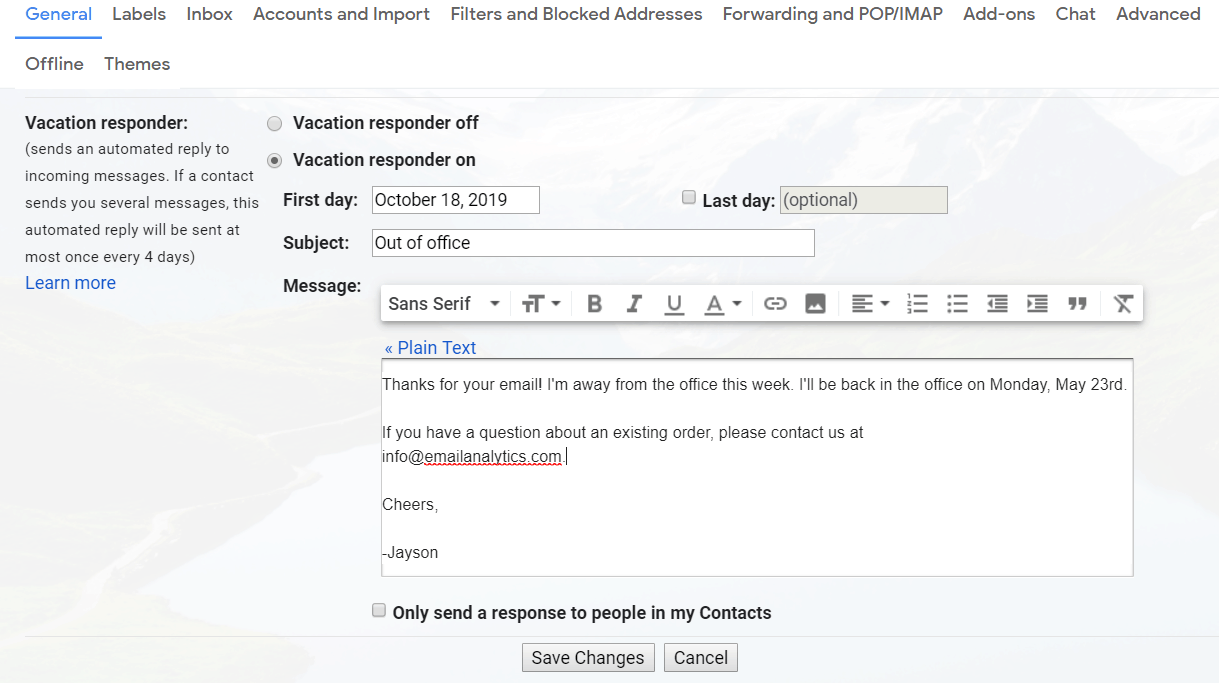
- Open Gmail and click Settings at the top right, then See all settings.
- Stay on the General tab and scroll to the Vacation responder section.
- Select Vacation responder on.
- Fill in the first day, last day, subject line, and message.
- To reply only to people you know, tick the contacts-only box under the message.
- Click Save Changes.
On the Gmail Android app, tap Menu, then Settings, choose your account, and tap Vacation responder. On iPhone and iPad, tap Menu, then Settings, then Vacation responder under Compose and Reply.
Two Gmail rules are worth knowing before you rely on this. Google states the responder “starts at 12:00 AM on the start date and ends at 11:59 PM on the end date.” Partial days don’t work the way people expect.
Google also states that “In most cases, your reply is only sent to people the first time they message you.” A sender gets your reply again if they contact you after four days, or if you edit the message.
Key insight
Google states that emails sent to your spam folder, or addressed to a mailing list you subscribe to, don’t get your vacation reply. That’s why your auto-reply never floods a list you’re on.
One more Gmail quirk: adding a subject line to your reply prevents an automatic reply inside that conversation thread. Google documents this as the way to stop a responder loop.
While you’re in there, it’s a good moment to set up a reminder for the first morning back.
How to Set Up Automatic Replies in Outlook
Outlook calls the feature Automatic Replies, and the path differs across the three versions people use. Microsoft states that Automatic Replies “are not supported for Gmail, Yahoo, or other POP or IMAP accounts.” The feature only appears on Exchange and Microsoft 365 mailboxes.
New Outlook for Windows: open the View tab, select View settings, then Accounts, then Automatic Replies. Turn on the toggle, set a time period, and type your message.
Classic Outlook for Windows: select File, then Automatic Replies. Choose Send automatic replies, set your date range, and type the response on the Inside My Organization tab.
Outlook on the web and Outlook.com: select Settings, then Accounts, then Automatic replies. Turn on the toggle, tick Send replies only during a time period, and enter your start and end times.
To reply to people outside your company, tick Send replies outside your organization and write a separate message there. Microsoft recommends limiting external replies to contacts only, which keeps your away dates away from strangers.
Example
Outlook on the web adds three check boxes Windows users don’t get: block my calendar for this period, automatically decline new invitations, and decline and cancel my meetings during this period. Set your auto-reply from the browser once and your calendar clears itself.
What to do if your Outlook account doesn’t support Automatic Replies
Personal Gmail, Yahoo, and other POP or IMAP accounts connected to Outlook need a rule instead. Microsoft documents the workaround in two parts.
- Compose your away message as a new email, then choose File, Save As, and pick Outlook Template (*.oft) in the Save as type list.
- Go to File, then Manage Rules & Alerts, then New Rule. Choose “Apply rule on messages I receive,” pick the action “reply using a specific template,” and select your file under User Templates in File System.
One catch that ruins this for a lot of people: Microsoft states you have to leave Outlook running for the rule to send anything. Close your laptop and the replies stop.
Out of Office Mistakes That Cost You
Four mistakes turn a useful auto-reply into a dead end, and I see all four every August.
- No named backup. “Someone from my team will respond” means nobody will. Name a person and give their address.
- Publishing your travel plans. “In Bali for three weeks” tells every stranger your house is empty. Give the return date and stop there.
- Forgetting to turn it off. Set an end date rather than relying on yourself to remember. Gmail and Outlook both support one.
- Leaving it on for a whole automated sequence. If you also run an email marketing campaign from the same address, your auto-reply can bounce back into your own reporting and skew the numbers.
When the tone is in doubt, send something simple and formal. Nobody has ever complained that an out of office message was too plain.
If your away message is doing real routing work, there are Gmail apps and Gmail add-ons that bolt scheduling links or intake forms onto it.
How Fast People Expect a Reply When You’re Back: What Our Data Shows
Across 25,384,649 emails in our own Q2 2026 email productivity benchmark, the average reply took 4h 10m in work hours. Measured in elapsed time, including nights and weekends, the average was 12h 55m.
Given those figures from our own benchmark, promise “within one business day” in your auto-reply rather than “today.” Half a working day is already the normal wait, and a one-day promise gives you room to clear the backlog.
How we measured those response times
- Our own data comes from aggregated, anonymized metadata from paying and trial EmailAnalytics customers on Gmail and Outlook.
- We collect metadata only, and we never read or store message bodies.
- Our own sample for Q2 2026 covers 25,384,649 emails across 22 industries, with industries self-reported at onboarding.
- Our own methodology excludes personal addresses, removes users with zero activity, and trims the top and bottom 5% of users by volume.
- Every timestamp is localized to each user’s own time zone.
One limit matters for out of office planning. These figures describe how fast people answer mail inside working relationships, so they say nothing about whether a cold sender ever gets a reply.
Neither Google nor Microsoft publishes any email response-time benchmark or target, which is why we publish ours every quarter.
How to Tell Whether Your Coverage Plan Worked
Almost nobody checks the one number that says whether the plan worked. Did the backup person you named reply any faster than you would have?
EmailAnalytics is a reporting tool that visualizes team email activity in Gmail and Outlook, including average response time per person. Across the 10,000+ teams using it, average email response time improves by 42.5%.
Point it at the week you were away and compare your team’s response time to a normal week. If the gap is large, your auto-reply is routing to the wrong person. Sign up for a free trial and the first dashboard takes about two minutes.
To be clear about what it doesn’t do: EmailAnalytics measures the inbox, it doesn’t run one. It won’t send your auto-reply or manage a shared queue, and it isn’t a help desk.
Frequently Asked Questions
How do I set up an out of office message in Gmail?
Click Settings at the top right of Gmail, choose See all settings, and scroll to the Vacation responder section on the General tab. Select Vacation responder on, enter your dates, subject, and message, then click Save Changes. Tick the box under the message to reply only to your contacts.
How do I set up an out of office message in Outlook?
In new Outlook for Windows, open the View tab, select View settings, then Accounts, then Automatic Replies. In classic Outlook, select File, then Automatic Replies, and on Outlook on the web go to Settings, then Accounts, then Automatic replies. Turn on the toggle and set a time period.
What do you say in an out of office message?
Say when you’re back, who to contact while you’re gone, and whether you’re reading email at all. Give the backup person’s full name and email address as plain text. Four short lines cover everything a sender needs.
How often does Gmail send a vacation reply to the same person?
Google states that in most cases your reply is only sent to a person the first time they message you. The same sender receives it again if they contact you after four days, or if you edit the reply in between.
Does an out of office message reply to spam and mailing lists?
No. Google states that emails sent to your spam folder, or addressed to a mailing list you subscribe to, don’t receive your vacation reply. That behavior is automatic and there’s no setting to change it.
Can I send different out of office messages to colleagues and clients?
Yes, in Outlook. Automatic Replies has separate messages for senders inside and outside your organization, and you can limit the external reply to your contacts. Gmail offers only one message, with an optional contacts-only restriction.
Why doesn’t my Outlook account have an Automatic Replies option?
Automatic Replies requires an Exchange or Microsoft 365 mailbox. Microsoft states the feature isn’t supported for Gmail, Yahoo, or other POP and IMAP accounts connected to Outlook. Those accounts need an Outlook template plus a rule, and Outlook has to stay running for it to fire.
Should I put my return date or my time away in the message?
Put the return date. A sender reading “back Monday, August 11” knows exactly when to follow up. “Away for two weeks” forces them to do the math from a date they can’t see.
What is a short out of office message?
A short out of office message gives your return date and one contact in a sentence or two. For example: “I’m out until Monday, October 13. For anything urgent, email Dana at dana@example.com.”
What subject line should an out of office message use?
Use your return date, such as “Out of office until Monday, October 13.” Gmail’s vacation responder has its own Subject field, so set it once when you turn the reply on.
How do you professionally say you will be out of office?
Say you’re away, give the date you’re back, and name one person who can help before then. “I’m out of the office until Monday, October 13, and Dana Reyes can help with anything urgent” covers all three.
Write the message once, name a real backup, and set an end date. Your doorman does the rest.

Jayson is a long-time columnist for Forbes, Entrepreneur, BusinessInsider, Inc.com, and various other major media publications, where he has authored over 1,000 articles since 2012, covering technology, marketing, and entrepreneurship. He keynoted the 2013 MarketingProfs University, and won the “Entrepreneur Blogger of the Year” award in 2015 from the Oxford Center for Entrepreneurs. In 2010, he founded a marketing agency that appeared on the Inc. 5000 before selling it in January of 2019, and he is now the CEO of EmailAnalytics and OutreachBloom.


